
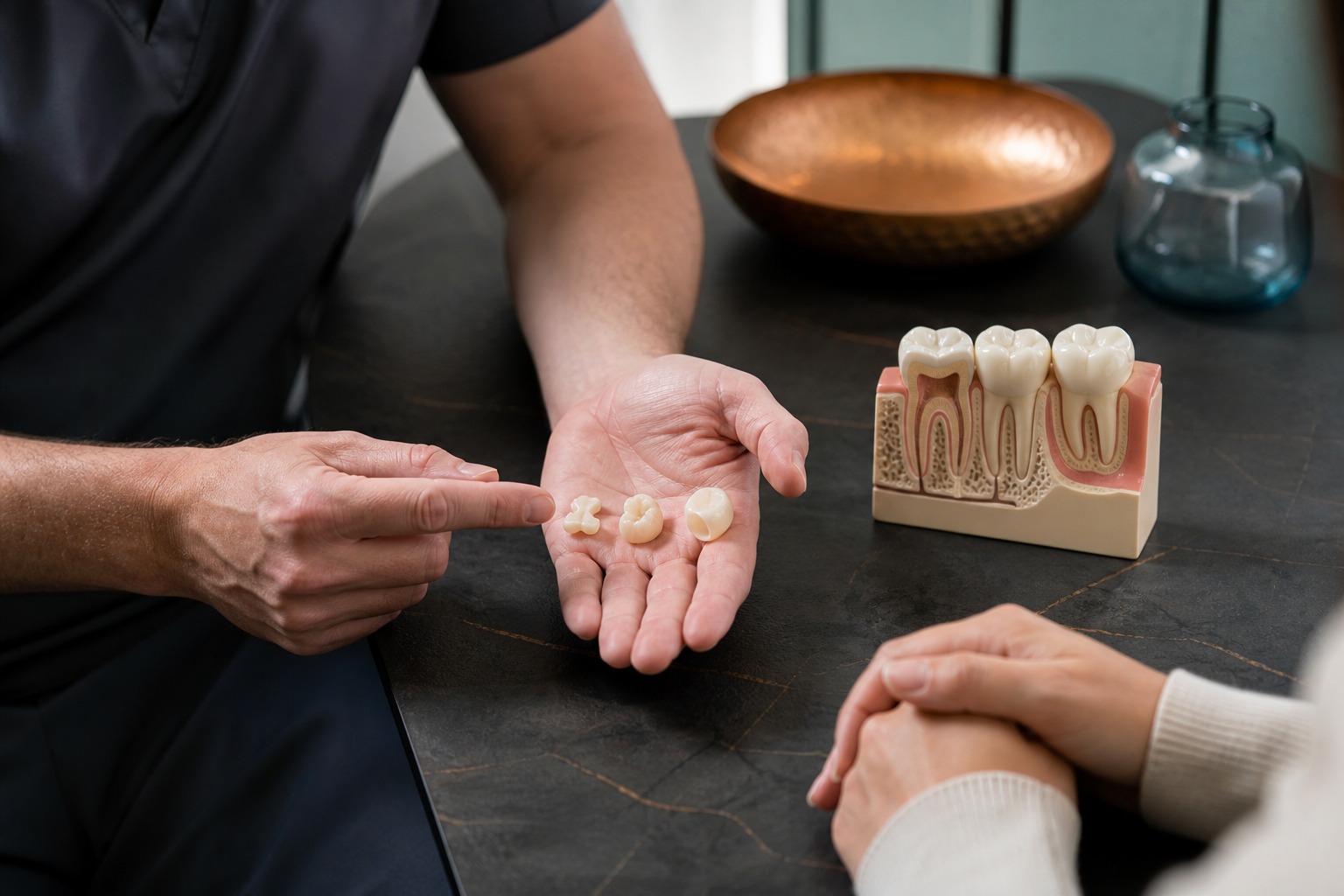
Inlays, onlays and crowns are indirect restorations made to repair a damaged tooth, often from ceramic, metal or composite material. Their main difference is how much of the tooth they replace and cover. An inlay sits inside the raised cusps, an onlay extends over at least one cusp, and a crown surrounds most of the visible tooth.
Those definitions help you understand a treatment discussion, but they do not select the restoration. The dentist must assess how much sound tooth remains, where forces fall and why the tooth needs treatment before balancing preservation, protection, appearance, maintenance and cost.
An inlay replaces a portion within the biting surface of a back tooth without covering the cusps. It may be considered when a cavity or failed filling is too extensive for a straightforward direct filling but the cusps remain suitably supported.
Because it is made outside the mouth or designed digitally, an inlay can reproduce contacts and anatomy precisely. However, indirect construction alone does not make it appropriate. The dentist needs enough suitable tooth to support and retain the restoration, and the margin must be placed where it can be finished and maintained.
If a cusp is cracked or undermined, leaving it uncovered can expose the tooth to further fracture. In that situation, an onlay or another design may be discussed instead.
| Restoration | Typical coverage | Potential reason to consider it |
|---|---|---|
| Inlay | Within the cusps | Moderate internal damage with supported cusps |
| Onlay | Internal surface plus one or more cusps | A weakened cusp needs coverage while other tooth tissue can be preserved |
| Crown | Most visible surfaces around the tooth | More extensive structural loss, fracture or restorative need |
This is a conceptual comparison, not a prescribing table. Teeth with similar-looking cavities can need different treatment because crack direction, material, bite and remaining wall thickness differ.
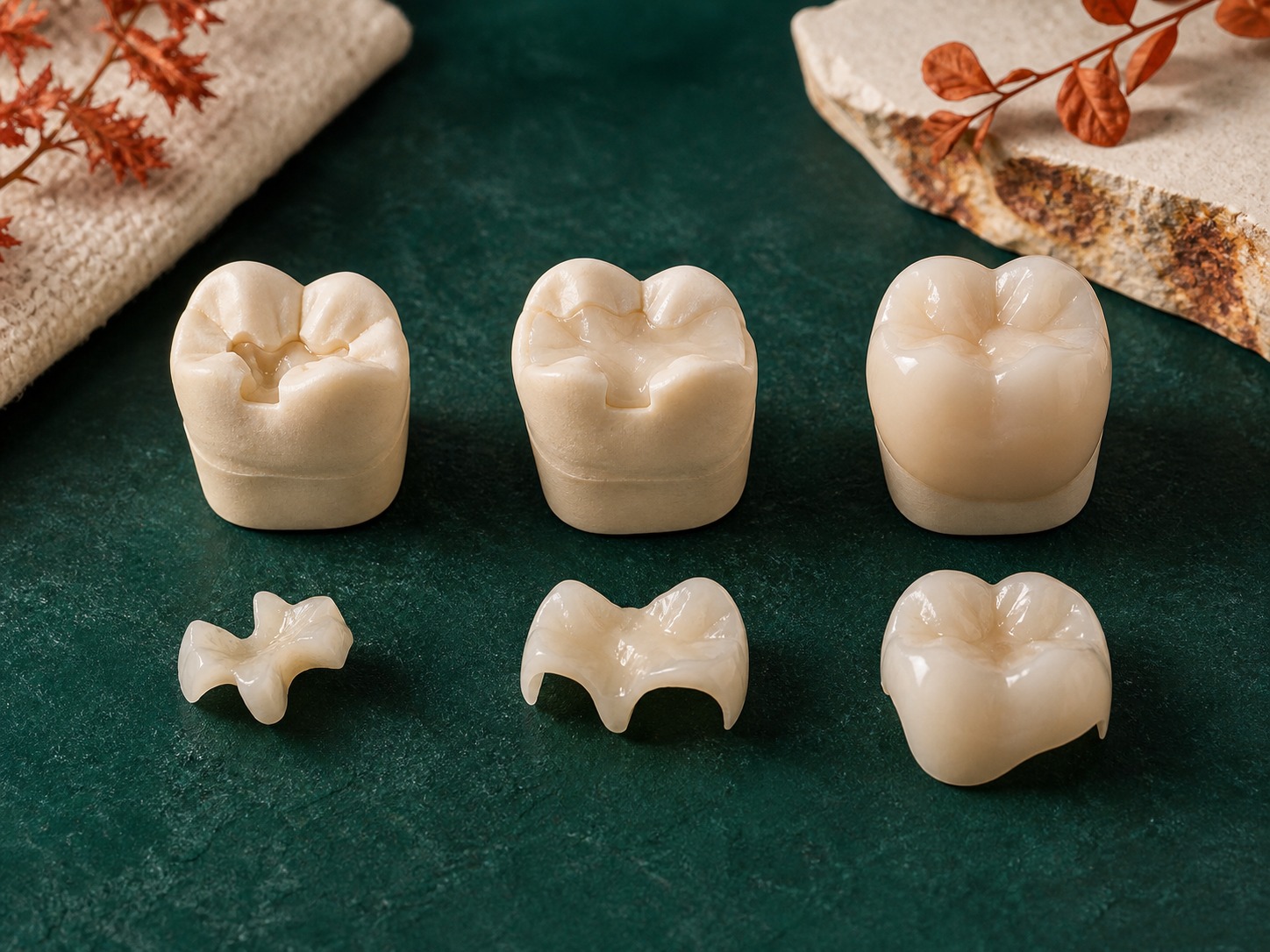
An onlay replaces the damaged internal area and covers one or more cusps. It is sometimes described as a partial crown because it protects selected biting surfaces without necessarily wrapping around the whole tooth.
This selective coverage can preserve suitable outer tooth tissue. It may be considered for a large failed filling, a weakened cusp or some cracked teeth where the damage and bite can be managed with an adhesive restoration.
Onlays still require tooth preparation and maintenance. Bonding needs a clean, controllable field, and the material and thickness must suit the forces. A deeply extending margin, limited isolation or extensive loss may alter the recommendation.
A crown covers most of the tooth above the gum, usually around its circumference and over the biting surface. It can restore shape and provide broader coverage when a tooth is heavily broken down, has a large fracture or needs a particular post-root-canal restoration.
A crown is not automatically required after every root canal treatment, and it does not reinforce an unlimited amount of lost structure. The remaining tooth, location and loading determine the restorative plan. Sometimes core build-up or other preparation is needed before the crown can be made.
Compared with a partial restoration, a crown generally involves more tooth reduction. That may be justified when broader coverage is needed, but unnecessary removal of healthy tissue is not a benefit. Read about dental crowns in Kingston for the canonical assessment and treatment pathway.
A restoration cannot be selected safely from symptoms alone. Severe or spontaneous pain, swelling, pain on biting or trauma may indicate decay, pulpal inflammation, infection or a crack. Seek urgent dental advice for facial swelling, fever with dental symptoms, difficulty swallowing or breathing, or significant trauma.
The examination looks at the amount and quality of remaining tooth, cavity depth, existing restoration, visible cracks, gum health, contact with neighbouring teeth and bite. Symptoms and tests help assess the dental pulp. An X-ray may add information about decay, roots or bone, but it cannot reliably reveal every crack.
Preserving sound tissue is weighed against protecting vulnerable cusps. A very conservative restoration that leaves a weak cusp exposed is not necessarily safer; a full crown that removes avoidable healthy tissue is not automatically superior. The design should solve the diagnosed structural problem.
Other factors include whether the area can be isolated for adhesive bonding, grinding or clenching, available thickness for the chosen material, appearance, repairability and the patient’s ability to clean the margins. Sometimes a direct filling remains suitable; sometimes the tooth cannot be restored predictably.
Ceramics can provide a tooth-coloured result and have different strength, translucency and bonding requirements. Gold and other metal restorations have a long clinical history and can be conservative in suitable situations, but their appearance is a clear consideration. Indirect composite may be used in selected cases.
No material is simply best. A strong ceramic can still fracture or wear an opposing tooth if design, thickness, finishing or bite is unsuitable. Metal may permit a different preparation but is visibly metallic. Material choice follows the restoration design and clinical conditions rather than a marketing label.
Whitening changes natural tooth colour but does not whiten established ceramic or metal. If colour treatment is planned, discuss the sequence before a visible restoration is matched.
After diagnosis and consent, the tooth is prepared under local anaesthetic where appropriate. Decay and unsupported material are removed while the planned form is created. A scan or impression records the tooth and bite for laboratory or chairside manufacture.
Some restorations can be produced in one visit; others need a temporary restoration while a laboratory completes the work. Protect a temporary by following eating and cleaning instructions and contact the practice if it breaks or comes out.
At fitting, the dentist checks seating, margins, contacts, colour where relevant and the bite before bonding or cementing. The restoration may feel new initially, but persistent high contact, pain or inability to floss needs review.
Book promptly if a tooth or restoration has fractured, become painful, feels loose or has changed your bite. Severe pain, swelling or trauma may need urgent triage. A symptom-free damaged restoration still deserves assessment because the remaining tooth and margins cannot be judged reliably at home.
Bring a current medicine list and explain when symptoms or damage began, what triggers discomfort and whether the tooth has had a large filling or root canal treatment. Previous records or X-rays can be useful when available, although the dentist decides whether new information is clinically justified.
The assessment considers what each restoration would cover and what affects the choice, then explains related treatment options available in Kingston. This may include a direct filling, inlay, onlay, crown, root canal care or extraction depending on the diagnosis; listing an option does not mean it is suitable for every tooth.
Brush twice daily with fluoride toothpaste and clean between teeth. Pay attention to the gum margin and contacts, because the underlying tooth can still develop decay. Avoid using restored teeth to open objects and discuss protection if you grind or play contact sport.
There is no guaranteed lifespan for an inlay, onlay or crown. Material, design, remaining tooth, decay risk, bite, habits and maintenance all affect performance. Reviews can identify margin changes, gum inflammation, wear or a developing problem in the supporting tooth.
Contact a dentist for a restoration that moves, fractures, catches floss, creates a new bad taste, becomes painful or changes the bite. Keep a detached restoration safely and never use household glue.
Fees vary with restoration type, material, records, laboratory work and any treatment needed to stabilise the tooth. Ask for the diagnosis, alternatives, material and written estimate rather than comparing labels alone.
Alternatives may include monitoring, a direct filling, a different partial restoration, a crown, root canal treatment before restoration, or extraction when the tooth cannot be predictably repaired. Each option has a different balance of tooth preservation, maintenance, risk and cost.
The dental fee guide provides broad starting information. A firm plan requires examination because “inlay versus crown” is a clinical design decision, not a choice based only on price.
Not universally. An onlay can preserve more suitable tooth tissue, while a crown may provide necessary broader coverage. Diagnosis determines which trade-off is appropriate.
Both repair a cavity, but an inlay is made outside the mouth or designed indirectly and then bonded or cemented into the prepared tooth.
A crown can protect a suitably restored tooth, but the tooth or crown can still fracture and no restoration removes every risk.
Not automatically. It is considered when the pulp is irreversibly inflamed, infected or otherwise requires treatment, based on clinical assessment.
Tooth-coloured materials are available for all three designs, but suitability, thickness, tooth colour and position influence the appearance that can be achieved.
Thames Street Dental can assess the remaining tooth, bite and symptoms before explaining filling, inlay, onlay or crown options.







 020 8546 6546
