
What should I do if composite bonding chips? Contact your dentist for advice. They can check whether the bonding or the tooth is damaged and explain whether smoothing, repair or another treatment is suitable.

A small change in a bonded front tooth can be unsettling, particularly when you are unsure whether the tooth itself has broken. A photograph or a mirror cannot reliably answer that question. Your dentist can assess the area and advise on the timing of an appointment. You can call Thames Street Dental on 020 8546 6546 to describe what happened.
| What has happened? | A sensible next step |
|---|---|
| A small chip, with no pain or injury | Contact your dentist for advice and an assessment. The team can help decide how soon you need to be seen. |
| Pain, swelling, a loose restoration or an injury | Ask for urgent dental advice. If you cannot reach a dentist, contact NHS 111. |
| Heavy bleeding that will not stop, or severe swelling affecting breathing | Call 999 or go to A&E. |
The NHS explains when to seek urgent dental care, including for a broken or loose restoration. If you are unsure which category fits, tell the dental team what you can see and feel.
Seek urgent dental advice after an injury to a tooth, especially if it feels loose, has moved or is badly broken. Serious facial or jaw injury, heavy bleeding that will not stop, or severe swelling with breathing difficulty needs emergency medical care. This guide cannot assess an injury online.
See the NHS guidance on a chipped or broken tooth for more about tooth fragments and dental care. A fragment of resin is not necessarily treated in the same way as a fragment of natural tooth.
Composite bonding uses tooth-coloured resin added to a tooth. It can be used for different purposes, including changing a tooth’s shape or rebuilding a worn edge. A chip may affect only that added material, but a tooth can also crack or break. Both may be involved after an accident.
A rough edge, a change in shape, sensitivity or an unfamiliar bite is useful information to share, but none proves which part is damaged. A dentist can check the bonding, the tooth, the surrounding gum and the way the teeth meet. An X-ray may be considered if it would help answer a clinical question; it is not automatic for every chip.
If you know a natural tooth has broken, read our guide to broken and chipped teeth. If you are uncertain, explain that when you call so the team can advise you.
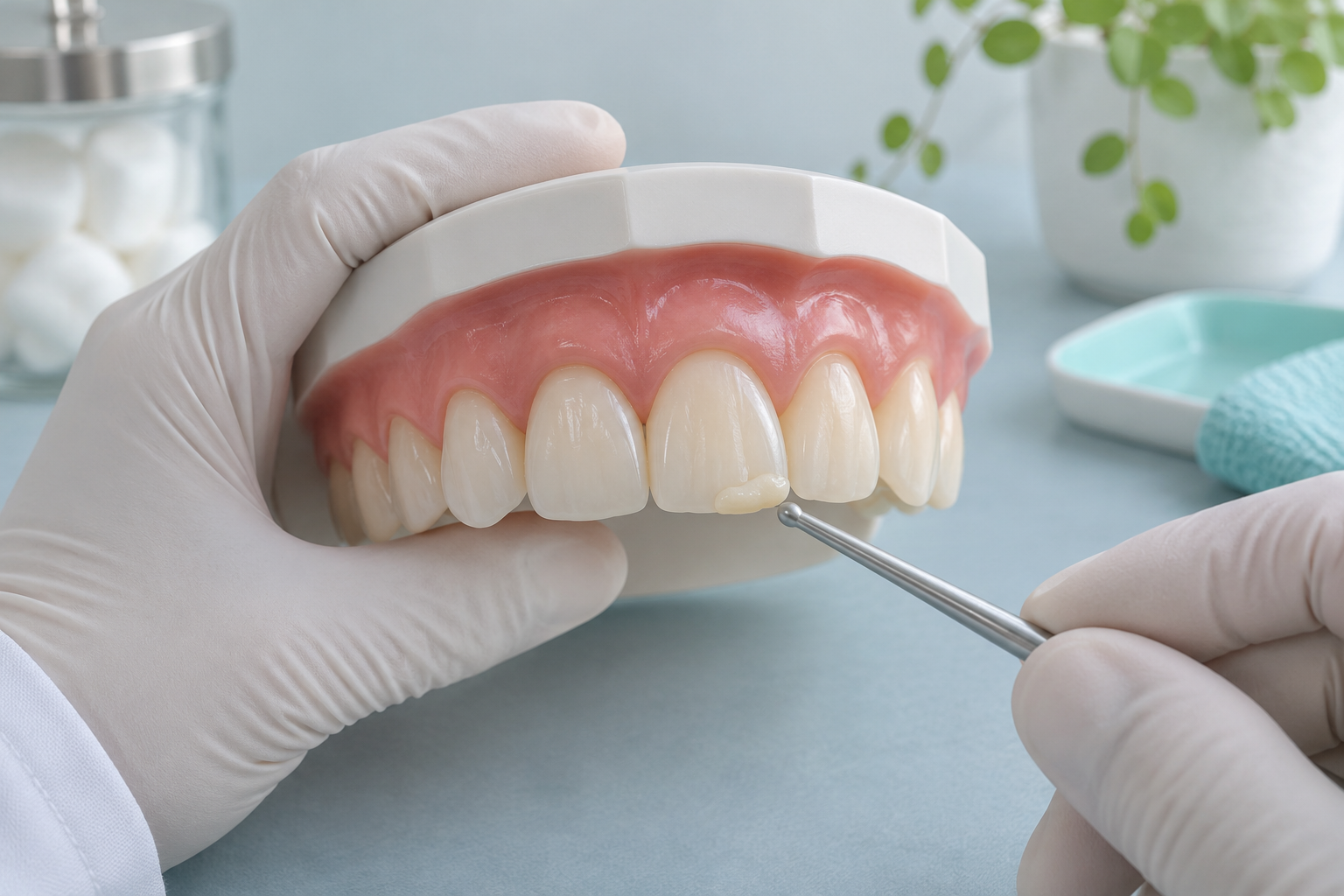
Often, a dentist can repair part of a composite restoration rather than replace everything. The University of Bristol Dental School explains that composite build-ups can be repaired or added to when they fracture or are lost. Its guidance concerns build-ups for worn teeth; the right approach to a cosmetic bonding chip still depends on an individual examination.
The options a dentist may discuss include:
None of these is automatic. The dentist may consider how much material remains, whether the tooth is healthy, the position of the chip, your bite and the appearance you want. A repair to one edge does not necessarily mean work is needed on every bonded tooth.
Composite can wear, stain or chip over time. Damage may follow a knock or biting something hard, but the cause is not always obvious. The shape and thickness of a restoration, how the teeth meet, and habits such as clenching or grinding may be relevant. A new chip does not, by itself, tell you that the original treatment was faulty.
If the same area chips repeatedly, mention that history. Your dentist can look at the tooth and bite rather than simply adding material each time. If you wake with a tired jaw or have noticed worn edges, our guide to signs of teeth grinding explains what to discuss at a check-up.
Follow the instructions given for your own treatment. For everyday care, the NHS recommends brushing twice daily with fluoride toothpaste and cleaning between teeth. Ask your dentist or hygienist to show you how to clean around any area that catches floss or is difficult to reach.
Avoid using teeth to open packaging or bite pens, nails or other hard objects. If you grind or clench, ask whether a protective appliance is appropriate for you. A guard cannot prevent every instance of damage, and a change in your bite or comfort deserves a review.
Bonding and veneers are different restorations. Both need individual care, and whether either is appropriate depends on the tooth and your goals. Bonding can also sometimes help close small gaps; a new gap or a change in the bite should be examined before deciding on a cosmetic repair. Our guide to bonding for gaps explains suitability in more detail.
The cost depends on the assessment, the size and position of the damage, and whether the dentist recommends smoothing, repair or replacement. The original practice may have a repair policy, so ask what it covers and whether any exclusions apply. Do not assume a repair is included or that a whole new treatment is necessary.
Use our treatment fee guide as a starting point and ask for an estimate for your own plan. The General Dental Council’s consent standards say patients should be given relevant treatment options and possible costs before treatment begins.
Not every small chip needs emergency treatment, but contact a dentist for advice. Ask for urgent advice if there is an injury, pain, swelling or a loose restoration. NHS 111 can help when you cannot reach a dentist.
Not necessarily. A dentist may be able to smooth or repair the damaged part, depending on the condition of the tooth and remaining material. More extensive problems may need a different plan.
No. Do not use household glue or try to file the area. Keep any loose piece safely and ask your dentist whether to bring it to the appointment.
A dentist can discuss shade and shape with you, but the match depends on the existing material, surrounding teeth and the treatment needed. Ask about this before the repair is started.
Discuss the timing with your dentist. Leeds Teaching Hospitals explains that whitening does not change the colour of existing fillings or veneers, so timing can affect the shade chosen for a repair.
Tell the Thames Street Dental team what happened and whether you have pain, sensitivity or an injury. We can help you arrange the right next step and discuss an assessment.
You can also contact the practice or read about composite bonding in Kingston.







 020 8546 6546

